
Safety & Risks
Refrigerant Leak in a Refrigerator: the Signs, the Real Risk, and the Right Response
The signs are unglamorous and mostly indirect. The compressor runs continuously and the cabinet never reaches temperature. The freezer manages something and the fresh-food side does not. Ice forms in an odd, localized patch on the evaporator rather than evenly. The machine is quieter than it used to be, because a compressor with little to compress does not sound the same. Occasionally there is a faint sweet or chemical smell near the machine, though most people never notice one. What matters more than the list is what follows from it: a sealed system is sealed, so a shortage means a leak, and adding refrigerant sends the same amount out of the same hole. Sealants sold for this do not repair a leak in a system that has to hold pressure and vacuum for another decade. The honest repair is to find the leak, repair it, evacuate the system properly and recharge by weight — and refrigerant handling is regulated work.
The full guide
Refrigerator freon leak symptoms: what it actually looks like
Search results for this are dominated by pages selling sealant, so let us get the important sentence out of the way first.
A sealed system is sealed. It leaves the factory with a measured charge and it is designed to hold it for the life of the appliance. If it is short, the refrigerant went somewhere — and adding more sends the same amount out of the same hole, usually within weeks.
:::
The signs, and why most of them are indirect
There is rarely a puddle and rarely a smell. What you get instead is a machine behaving as though it is trying very hard and achieving very little.
- The compressor runs continuously and the cabinet never reaches temperature. The single commonest report.
- The freezer manages something and the fresh-food side does not. With little refrigerant in circulation, what cooling there is stays where it is made.
- Frost in a strange, localized patch on the evaporator rather than evenly across it — one corner iced and the rest clear.
- The machine has become quieter. People almost never mention this and it is a genuine sign: a compressor with less to compress does not sound the same.
- Occasionally a faint sweet or chemical smell near the back of the machine. Most owners never notice one.
Notice that every item on that list is also produced by something cheaper — a dirty condenser, a stopped evaporator fan, a defrost circuit that has given up, a door that no longer seals. That overlap is exactly why refrigerant is diagnosed last.
Is it dangerous?
Proportionately, no, and it is worth being accurate rather than alarming.
A domestic refrigerator holds a very small charge — in most modern machines a hydrocarbon refrigerant in quantities measured in grams. It is flammable, which is why the appliance is built and labeled the way it is, and why you do not want a naked flame behind a machine you suspect. It is not a toxic-cloud event, and it does not make a kitchen unsafe to stand in.
What to do is ordinary: ventilate the room, stop using the appliance, and have it looked at before somebody works behind it.
Why the repair is expensive, and why the shortcuts fail
The honest sequence is: recover the remaining refrigerant, pressure-test to find the leak, repair it, evacuate the system to pull out moisture and air, and recharge by weight rather than by pressure.
The evacuation step is the one that gets skipped, and it is the reason a sealed-system repair sometimes fails within a year. Moisture left in a system freezes at the metering device and blocks it; air left in it will not condense and the machine never performs.
That, plus the fact that on this maker a great many of these cabinets are integrated and have to come out of an opening cut for them, is why sealed-system work sits in a researched market range of roughly $600 to $1,500 parts and labor.
The conversation you should be having
Not "is it the sealed system" but three questions:
- What was measured to rule out the cheaper causes? Compartment temperatures, airflow, defrost, condenser, fans, controls. Ask, and expect an answer.
- What is this cabinet worth to replace, including the kitchen around it? An integrated column is an appliance job and a cabinetry job. A small freestanding machine is a delivery.
- What else on this machine is the same age? A sealed-system repair on a cabinet whose fans, seals and boards are all a decade old is a different proposition from one on a five-year-old machine.
:::
The rule we hold ourselves to
We quote this repair last, we show you what was measured to get here, and where a repair approaches the value of the appliance you get told that instead of a quote — including when saying so costs us the work.
Refrigerant handling is also regulated. Certification is not a nicety on this job; it is the law, and a shop that is casual about it is being casual about other things too.
If it turns out to be a repair
What this leads to, and what it costs
Every job on this site is priced the same way: an on-site diagnostic first, the figure agreed in writing before anybody starts.
-

from $650 Refrigerator sealed system repair
The compressor, the evaporator, the condenser and the tubing between them. The highest figure on this site, quoted last and only after everything cheaper has been ruled out — and on a cabinet worth less than the repair, we say so instead of quoting.
- Quoted only after airflow, defrost and controls are excluded
- EPA-certified refrigerant handling
- An honest view on whether the cabinet is worth it
-

Fresh food side going warm Refrigerator not cooling
The fresh-food compartment drifting up while the freezer stays cold. That combination is good news more often than not, because a working freezer proves the sealed system is doing its job and puts the problem somewhere ordinary.
- Freezer cold, refrigerator warm
- The machine runs constantly and never arrives
- It got worse over days rather than overnight

Questions people ask about this
Is a refrigerant leak dangerous in the house?
In a domestic refrigerator the quantity is very small, and the modern refrigerant used in most of them is a hydrocarbon in quantities measured in grams. It is flammable, which is why the appliance is built and labeled the way it is, and why you do not want a naked flame at the back of a machine you suspect. It is not a toxic-cloud situation. Ventilate the room, do not use the appliance, and get it looked at.
Can it be topped up?
No, and anybody offering to is not doing you a favor. A sealed system holds a measured charge for the life of the appliance. If it is short, the refrigerant went somewhere, and adding more sends the same amount out through the same opening — usually within weeks. The leak is found and repaired or the job is not done.
What about the sealants sold for this?
They are sold for automotive and HVAC systems and they are a poor idea in a domestic refrigerator, which has capillary tubing with an internal diameter smaller than a pencil lead. What blocks a leak can just as easily block that, and then you have a sealed system with a restriction as well as a hole.
How do you find a leak?
Pressure testing and electronic detection rather than guesswork, and it takes time — which is part of why this is the highest figure on the site. The system is recovered, tested, repaired, evacuated to remove moisture and air, and recharged by weight rather than by pressure. Skipping the evacuation is a common shortcut and it is why some sealed-system repairs fail within a year.
Is it worth repairing?
It depends entirely on the cabinet, and that is not a dodge. On a 30-inch integrated column built into millwork cut for it, a sealed-system repair is straightforwardly worth doing — replacing it is an appliance job and a cabinetry job. On a small freestanding machine the same repair often approaches what it is worth. You should get that arithmetic in plain words along with the figure.
How do I know it is not something cheaper?
By what was excluded and how. Compartment temperatures measured, airflow checked, the defrost circuit read, the condenser inspected, the fans and the controls tested. A diagnosis that reaches refrigerant early is not measuring — and refrigerant is the rarest cause on a list where the top three are cheap.
Safety & Risks
More guides like this one
-
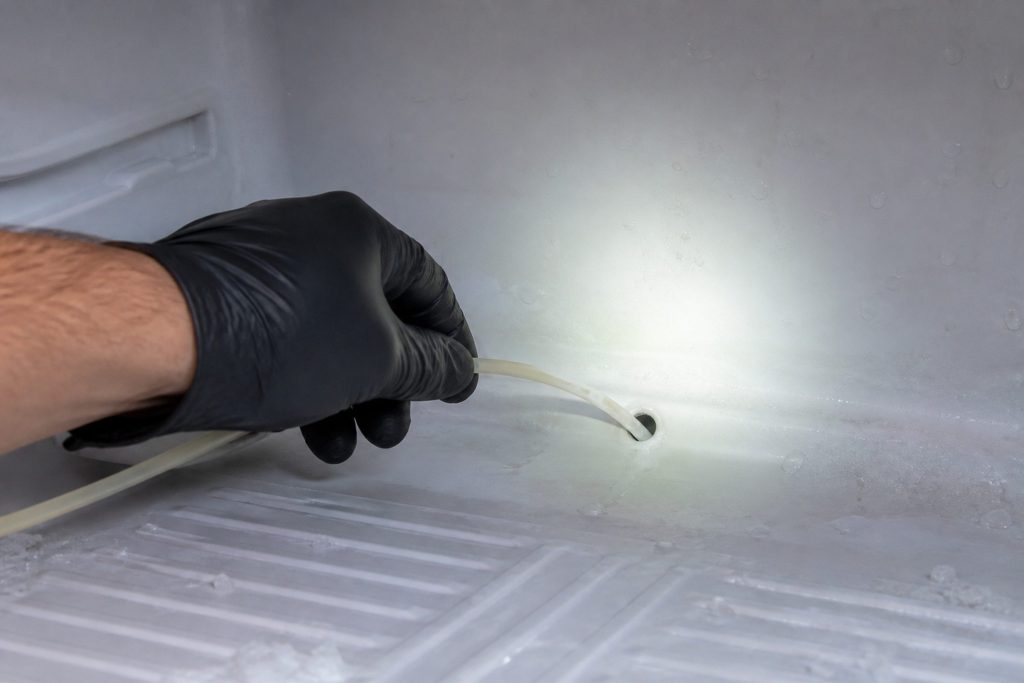
Mold in the Refrigerator Drip Pan: Where It Grows and How to Clear It
Everybody cleans the shelves. Almost nobody cleans the pan under the machine or the drain line into it — which in eight humid months a year is where the smell actually comes from.
Read more -
Grease Fire on a Cooktop: the Thirty Seconds That Decide It
Lid on, heat off, do not move the pan, never water. Everything else is written for somebody with time to read, and in this situation nobody has any.
Read more -
Gas Smell From the Oven: What Is Normal, What Is Not, and What to Do First
Two situations wear the same description and they need opposite responses. Which one you have is decided by a single question: is the appliance running?
Read more
Tell us the model number and what it is doing.
This article is based on:
- Official manufacturer documentation
- Internal repair procedures
- Technician repair history
- Company quality standards