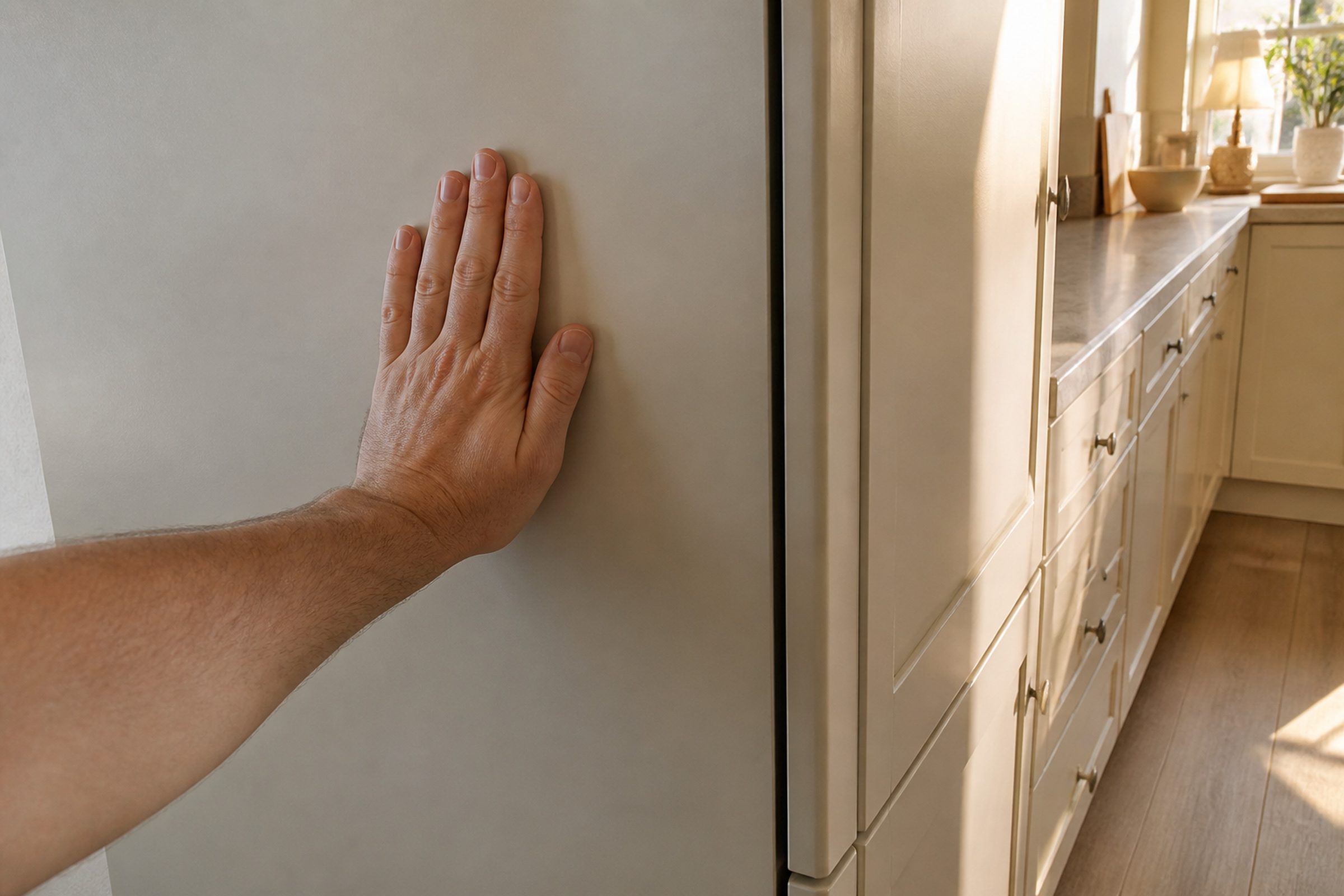
- “Warm panels around the door frame”
- “A warm strip down the middle of a column pair”
- “It is worse in summer”
Symptom
Fisher & Paykel the outside of the refrigerator feels warm
The most-linked refrigeration article this maker publishes — it appears on forty-nine of its models — and the answer is usually that the machine is working correctly. Which is worth saying plainly before anybody spends anything.
- From $95 diagnostic, credited to the repair
- 59 cities and neighborhoods covered
- OEM parts available on order
- In writing the price, before anything is opened
Five ordinary causes
What this usually turns out to be
Cheapest and commonest first, which is also the order we check them in. They sit hundreds of dollars apart, and only the unit settles which one is yours.
-
The condenser loop in the cabinet walls
By design. The heat has to leave somewhere, and on a built-in machine part of that somewhere is the frame.
Appliance maintenance visit from $135 -
The anti-condensation heater
Also by design, and specifically for climates like this one. It keeps the frame above dew point so moisture does not form on it.
Appliance maintenance visit from $135 -
A condenser that cannot shed heat
When it is warm AND the machine runs constantly. Dust, salt, or an installation with no air around it.
Appliance maintenance visit from $135 -
A door not sealing
Warm frame plus a compartment drifting, plus condensation at the seal. The machine is fighting a continuous load of warm air.
Refrigerator door, seal & panel repair from $145 -
A new warm patch on an old machine
Warmth that appeared suddenly where there was none is the version worth investigating rather than accepting.
Refrigerator control & sensor repair from $195
In five minutes
Before you call anybody
None of it needs tools, and all of it makes the visit shorter.
-
01
Measure inside
If both compartments are where they should be, the outside being warm is not a symptom.
-
02
Notice where the warmth is
Around the door frame and down the center of a column pair is expected. A hot patch on a side panel is not.
-
03
Listen to how often it runs
Warm and cycling normally is fine. Warm and running continuously is a condenser or a door.
-
04
Look for condensation
On the seal or the frame. Warm frame plus wet frame at the same time is worth reporting.
-
05
Then book if it fits the second picture
Warm plus drifting, warm plus continuous running, or a warm patch that is new.
How it shows up
What people describe when they call

In more detail
About Fisher & Paykel the outside of the refrigerator feels warm
The fastest diagnosis is the code
Check whether the compartments are still holding temperature. Warm on the outside with correct temperatures inside is the machine doing what it was designed to do — the condenser loop runs through the cabinet walls and an anti-condensation heater warms the frame deliberately, and in August in Miami both will be noticeably warm. Warm on the outside with a compartment drifting up is a different conversation.
Why it is warm on purpose
Two reasons, and both are design. A built-in machine has nowhere convenient to put a condenser, so part of the heat is shed through the cabinet walls and frame. And a machine sold into humid climates carries an anti-condensation heater around the frame to keep it above dew point, so moisture forms on the glass in your kitchen and not on the appliance.
The version that is a symptom
Warm and a compartment drifting up. Warm and running continuously. Or a warm patch that has appeared where there never was one. Those three are worth a call; a warm frame on a machine holding temperature is not.
Why the maker publishes it on forty-nine models
Because it is asked constantly, and because the honest answer costs the owner nothing. We would rather repeat it here than have you pay a diagnostic to be told your refrigerator is fine.
This article is based on:
- Official manufacturer documentation
- Internal repair procedures
- Technician repair history
- Company quality standards

Before you book
Questions about Fisher & Paykel the outside of the refrigerator feels warm
How warm is too warm?
There is no single number worth publishing, and anybody who gives you one is guessing about your kitchen. The useful test is not the temperature of the panel but what is happening inside: compartments holding their setting, and a machine that cycles rather than running continuously. Those two answers settle it.
The middle strip between the two doors is hot.
That is the anti-condensation heater, and in a humid climate it is exactly what you want. Without it, moisture forms on the frame between a refrigerator and a freezer and eventually gets into places it should not. The maker publishes an article on the central door seal feeling warm for the same reason: it is the design, not a defect.
Should I be worried about the electricity it uses?
Not for the heater — it is small. What genuinely costs money is a dirty condenser or a door that does not seal, because those make the compressor run for hours it should not. Both are cheap to put right, and both show up as a machine that never seems to stop.
Where we do it
Across Miami-Dade, Broward, and Palm Beach
Same terms everywhere we go: an on-site diagnostic first, the price agreed in writing, and the exact figure confirmed once we have seen the unit.
Neighborhoods people ask for by name