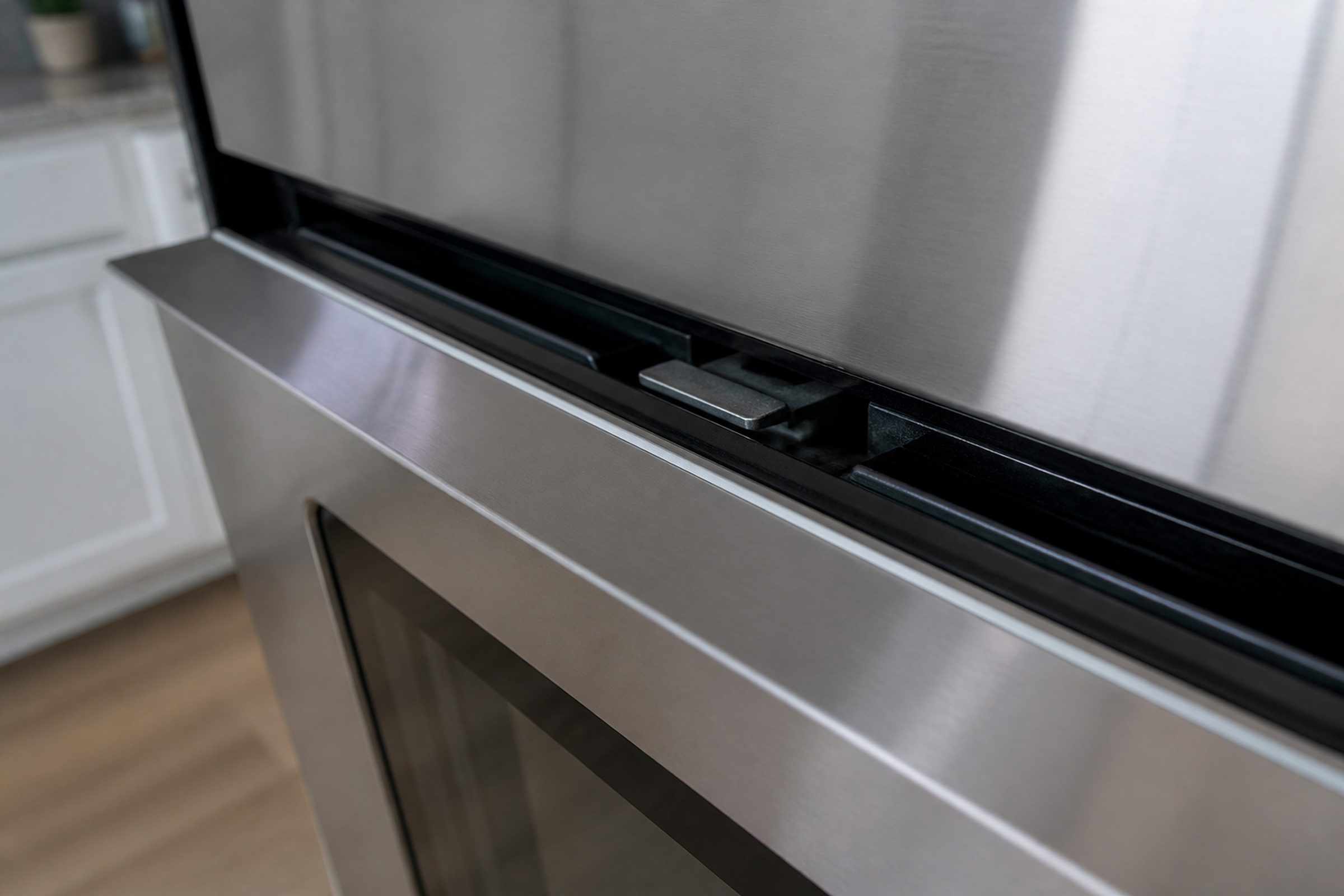
- “The cycle has ended and the door stays shut”
- “A3 showing on the display”
- “The oven feels cool on the outside”
Symptom
Fisher & Paykel oven door locked after a self-clean cycle
A door that will not release when the cycle has finished. The lock is driven by temperature rather than by a timer, so the first thing to try is time — and the one thing not to try is force.
- From $95 diagnostic, credited to the repair
- 59 cities and neighborhoods covered
- OEM parts available on order
- In writing the price, before anything is opened
Five ordinary causes
What this usually turns out to be
Cheapest and commonest first, which is also the order we check them in. They sit hundreds of dollars apart, and only the unit settles which one is yours.
-
The cavity is still hot
Not a repair at all, and the answer in a real share of these calls. The interlock is doing what it was designed to do.
Oven door & self-clean lock repair from $165 -
The control needs a reset
The maker publishes power off and on for A3. It works often enough to be the first thing anyone tries.
Oven door & self-clean lock repair from $165 -
The latch motor
Has driven the lock closed and cannot drive it back. A common repair, and a small one if nobody has pulled on the door.
Oven door & self-clean lock repair from $165 -
The position switch
The lock has released and the control does not believe it. Same symptom, different part.
Oven door & self-clean lock repair from $165 -
A power cut during the cycle
The maker publishes an article for an oven showing 12:00 with a locked door after an outage. Setting the clock is often the whole fix.
Oven control & display repair from $215
In five minutes
Before you call anybody
None of it needs tools, and all of it makes the visit shorter.
-
01
Give it two hours
From the end of the cycle, with the door shut. Most of these open by themselves in that window.
-
02
Feel inside the door glass, not the front
The outer skin cools long before the cavity does.
-
03
Power off at the wall, then on
The maker's own instruction for A3, and free.
-
04
Set the clock
If there was an outage, the control may be refusing to act until it knows the time. It sounds trivial and it is often the answer.
-
05
Then book the visit
Say what code is showing, how long since the cycle ended, and whether anybody has pulled on the door.
How it shows up
What people describe when they call

A shortcut
Narrow it down before anybody arrives
A description of the behaviour leaves a few possible causes. A code names the subsystem before anybody opens anything, which is why it is worth photographing before it clears.
If the display is showing something
- A3 Door lock error: the door could not be
- A2 Door lock error: the door could not be
- A3 Door lock error: the door could not be
- A2 Door lock error: the door could not be
Photograph it before it clears — codes do not wait. Search the full code list
In more detail
About Fisher & Paykel oven door locked after a self-clean cycle
The fastest diagnosis is the code
Wait, and do not force it. The interlock releases on temperature, and a cavity that has run a full clean cycle stays hot inside long after the front feels cool — a couple of hours is normal on a 30-inch oven with the door shut. If it is genuinely cold and still locked, the maker's own instruction for A3 is to turn the power off at the wall and back on, then touch the oven door to help the lock disengage.
The lock is a thermometer, not a clock
It releases when the cavity is genuinely cool, and a self-clean cycle leaves a cavity hot long after the door front feels normal. This is why the honest first answer is to wait, and why a real share of these calls end before anybody arrives.
The maker's own sequence
For A3: power off at the wall, power on, then touch the oven door to help the lock disengage. For A2: power off, wait ten seconds, power on, set the clock, and restart the cycle with the door firmly closed. Both are free and both are what we would do first.
When it is a repair
A cold oven, a reset tried, and the door still locked. At that point it is the latch motor or the switch that reports its position — an ordinary job, and a much smaller one than the door repair that follows forcing it.
This article is based on:
- Official manufacturer documentation
- Internal repair procedures
- Technician repair history
- Company quality standards
Before you book
Questions about Fisher & Paykel oven door locked after a self-clean cycle
How long should I wait?
Two hours from the end of the cycle is a reasonable line, with the door left shut the whole time — opening it is impossible anyway and checking the handle every ten minutes does not help. A great many of these release during that window, which is why the first advice on this page is not a repair.
Can I force it open?
You can, and it is the most expensive thing available on this page. The latch is a small motorized mechanism; the door, its hinges and its glass are not. Pulling on a locked oven door converts a latch repair into a door repair, and on these machines that is a considerable difference.
What is the difference between A2 and A3?
A2 means the door could not be locked when a clean cycle started, so the cycle never ran. A3 means it could not be unlocked when the cycle finished. Same mechanism, opposite ends. Telling us which one you have saves a step, because the first thing to try is different for each.
Where we do it
Across Miami-Dade, Broward, and Palm Beach
Same terms everywhere we go: an on-site diagnostic first, the price agreed in writing, and the exact figure confirmed once we have seen the unit.
Neighborhoods people ask for by name