Cost Expectations
Oven Thermostat and Sensor Replacement: the Cheapest Part, the Commonest Cause
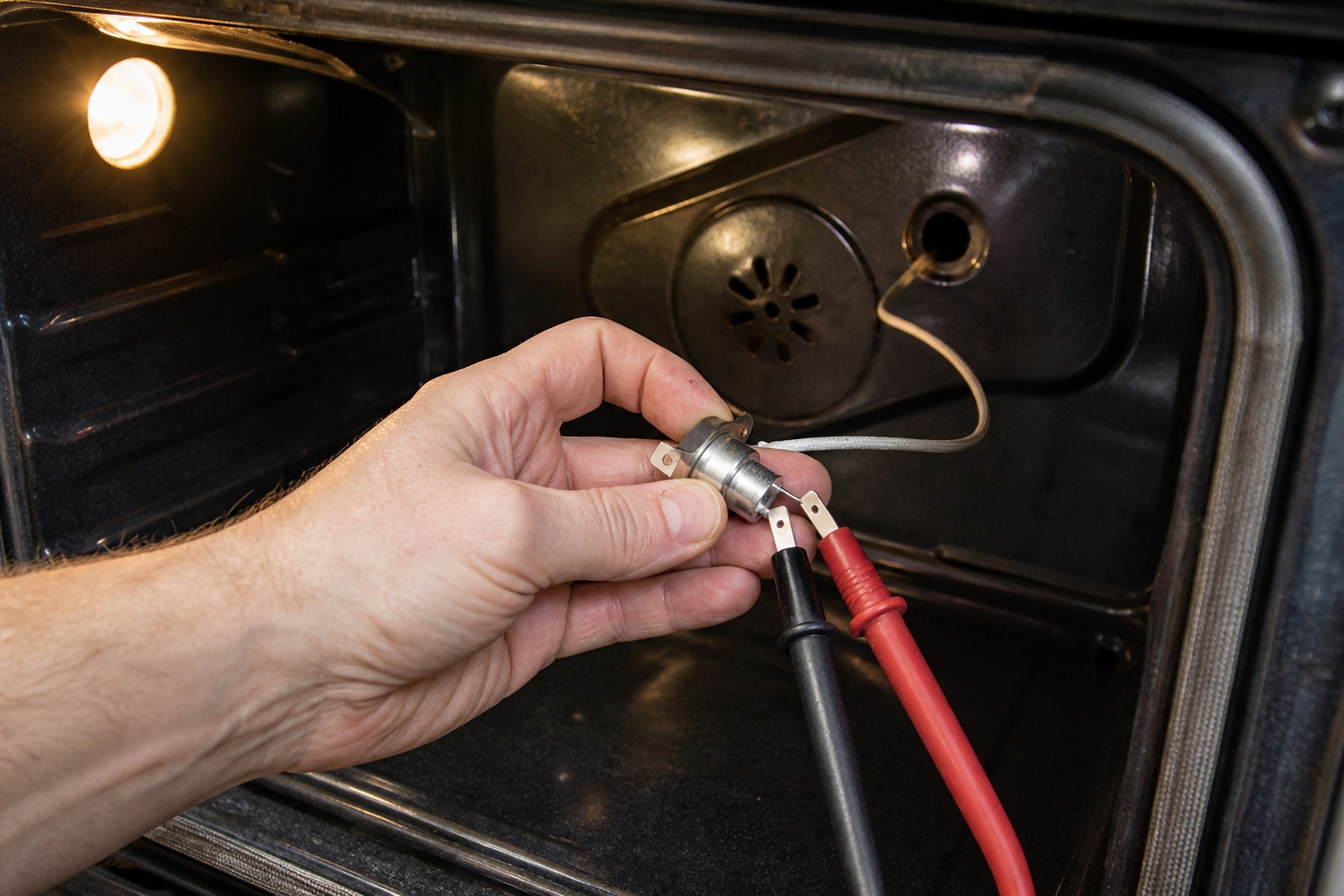
A temperature sensor is the least expensive part inside an oven and the cause of the widest set of complaints — running hot, running cold, browning unevenly, and taking longer than the recipe says. It drifts before it fails, which is why an oven can look completely healthy and cook badly for a year before anybody suspects it. Measuring it takes minutes: it is a resistance at a known temperature, and the reading either matches the specification or it does not. That is why any competent visit starts there rather than at the control board, which costs several times as much and is the answer far less often. Researched market ranges for South Florida put oven element and sensor work at roughly $180 to $420 parts and labor, against $220 to $600 for control-board work. If a quote goes straight to a board without a sensor reading, ask what was measured.
The full guide
Oven thermostat replacement cost, and why the sensor comes first
Search results for this question are dominated by control boards, because control boards are what people are quoted. The part that is actually behind most of the complaints costs a fraction of one, and it is the reason a good visit starts with a multimeter rather than a catalog.
An oven temperature sensor is a resistance that changes with temperature. The control reads it and decides whether to switch the element on. There is no cleverness in it and almost nothing to go wrong — except that over years it drifts, reporting a cavity as hotter than it is.
The word that matters: drifts
A sensor rarely fails outright. It drifts, and that is what makes it so hard to catch.
An oven reading a few percent low still heats. It still preheats, still signals, still looks entirely healthy. What it does is cook badly, gradually, for a long time — until somebody bakes something familiar in it and notices that the recipe has stopped working.
Four complaints, one part:
- everything takes longer than it used to;
- one side browns before the other;
- the top of a cake is done and the middle is not;
- the oven never quite reaches the temperature on the display.
The test you can do before calling anybody
An oven thermometer costs a few dollars and settles this.
- Put it in the middle of the cavity, on a rack, not touching a wall.
- Set the oven to 350°F and let it run for at least twenty minutes past the preheat signal — the air reaches temperature long before the walls do.
- Read it. A machine that reads within about 15 degrees is normal; one that is 30 or 40 degrees out is telling you something.
:::
Bring that number to the call. It is worth more than any description, and it shortens the visit considerably.
What the market says, and what it means for the order of work
Researched ranges for South Florida, parts and labor together:
| Work | Market range |
|---|---|
| Element and temperature sensor | $180 – $420 |
| Door latch, hinge and glass | $160 – $400 |
| Control board or display | $220 – $600 |
The gap between the first row and the last is the whole argument for measuring first. A sensor that is out of specification is a cheap part with an accurate diagnosis. A board quoted against a symptom the sensor explains is an expensive way to be wrong.
The self-clean footnote
If your oven stopped heating and the last thing it did was a self-clean cycle, say so when you book, because it changes where the visit starts.
Self-clean drives a cavity far above any cooking temperature, and the thermal cut-out that exists to protect the oven is exactly what opens afterwards. It leaves you with a live display and a completely cold cavity, which looks like a dead oven and is an ordinary repair.
What Fisher & Paykel tells you, and what it does not
Three alert codes with published meanings — A1 for an overheated oven, A2 and A3 for the two ends of the self-clean lock — plus A5 where there is a microwave system. Everything after that is an F number, and the maker groups around sixty of them into four families with a single instruction for all of them.
So on this make the display will place your problem in the sensing half or the control half of the oven and stop there. Useful, and not a substitute for the measurement. Anybody publishing a precise meaning for each F number on this maker is not reading it off the manufacturer's paper.
What decides your figure
Which part, and how the oven comes forward out of its housing. A compact steam or speed oven high in a run of cabinetry and a single wall oven under a counter are the same repair and not the same appointment.
Every figure on this site is a from, the ranges above are the market's rather than ours, and the exact cost is confirmed after an on-site diagnostic and agreed in writing before anything is opened.
If it turns out to be a repair
What this leads to, and what it costs
Every job on this site is priced the same way: an on-site diagnostic first, the figure agreed in writing before anybody starts.
-
from $185 Oven heating & sensor repair cost
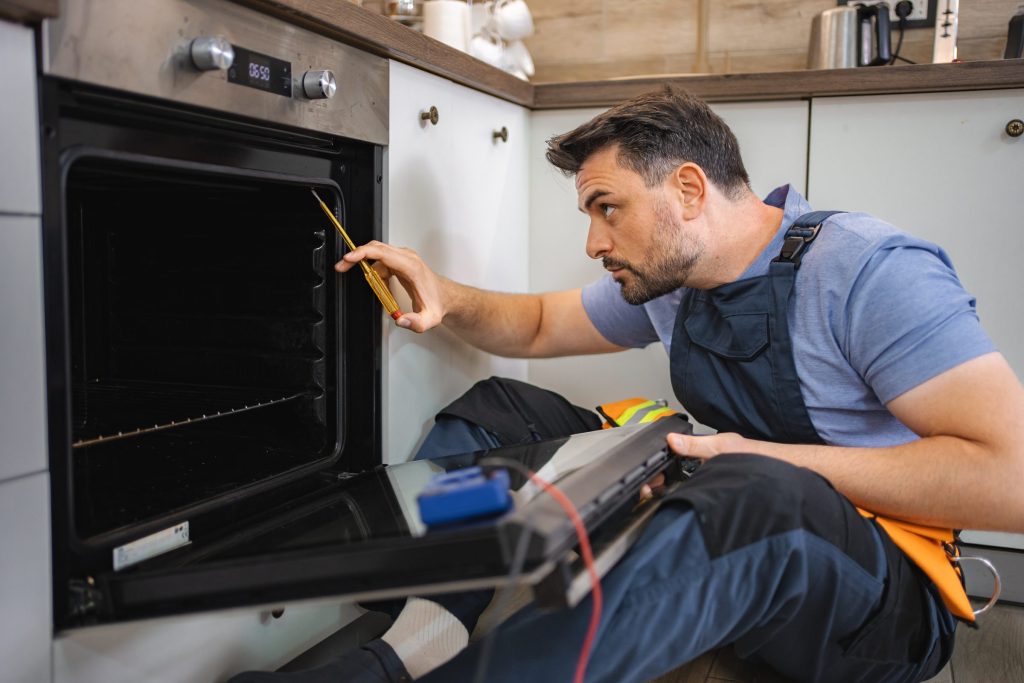
Elements, temperature sensors, relays and the thermal cut-out that opens after a self-clean cycle. The cheapest part on this list is also the commonest cause, which is a good combination for you and a poor one for anybody who prefers selling boards.
- Researched market range for South Florida: element and sensor work $180–$420
- Sensor measured before anything is ordered
- The thermal cut-out checked on any oven that has self-cleaned
-

Browning on one side Oven baking unevenly
Cakes rising crooked, one tray browning while another stays pale, or an oven that is simply not what it was. Sensor and convection fan long before elements — and some of this is not a repair at all.
- One side or one shelf browns faster
- Everything takes longer than the recipe says
- It crept up rather than failing suddenly
Questions people ask about this
How do I know it is the sensor and not the element?
By what the oven does. An element that has failed gives you no heat at all — the display is live and the cavity stays cold. A sensor that has drifted gives you heat that is simply wrong: everything browning too fast or too slow, or a preheat that never signals. A cheap oven thermometer in the middle of the cavity settles it in one bake.
Can the oven be calibrated instead of replaced?
Sometimes, and it is worth asking. Many ovens allow an offset to be set in the control, which corrects a small, consistent error. What it does not fix is a sensor that reads differently at different temperatures, which is what a genuinely tired one does — correct at 300 and forty degrees out at 450. That needs the part.
Is 'thermostat' the same thing as the sensor?
On a modern oven, effectively yes, though the words come from different eras. Older ovens used a mechanical thermostat with a bulb and a capillary. These use an electronic temperature sensor and a control that switches the element. People still say thermostat, and it is the sensor they usually mean.
My oven has never been accurate. Is that a repair?
It might be, and it might be the offset never having been set for your kitchen. A brand-new oven that runs consistently ten degrees low is a calibration conversation; one that has changed is a sensor conversation. Which of those you have is worth establishing before anything is ordered.
Why does this matter more on a built-in oven?
Because the part is cheap and reaching it is not. On a wall oven in a tall housing, the machine comes forward out of the cabinet, and that is planned time in the figure. It is also why doing the measurement first is worth so much: nobody wants to make that trip twice.
What does Fisher & Paykel publish about this?
Three alert codes with meanings — A1 for an overheated cavity, A2 and A3 for the self-clean door lock — plus A5 on machines with a microwave system. Everything else is an F number, and the maker groups those into families without a meaning for each one. So on this make the code will tell you which half of the oven to start in and no more, which is exactly why the measurement matters.
Cost Expectations
More guides like this one
-
Wine Cooler Repair Cost: When Two Degrees Is Worth a Service Call
For a cabinet whose whole function is holding a narrow band, two degrees is a symptom rather than a rounding error. What it costs depends on one question: one zone, or both.
Read more -
How Much Does a Refrigerator Repair Cost, and What Actually Moves the Number
Three things decide it, and only one of them is the part. This is the page that comes before the cost pages: which component, how the machine comes out, and whether it is worth doing at all.
Read more -

Cracked Glass Cooktop: Replacement Cost, and Why There Is No Repair
Nothing fills a crack in a cooking surface and survives the heat. The glass is a barrier as well as a surface, which is why this is a replacement and why the first advice is to switch it off at the wall.
Read more
Tell us the model number and what it is doing.
This article is based on:
- Official manufacturer documentation
- Internal repair procedures
- Technician repair history
- Company quality standards