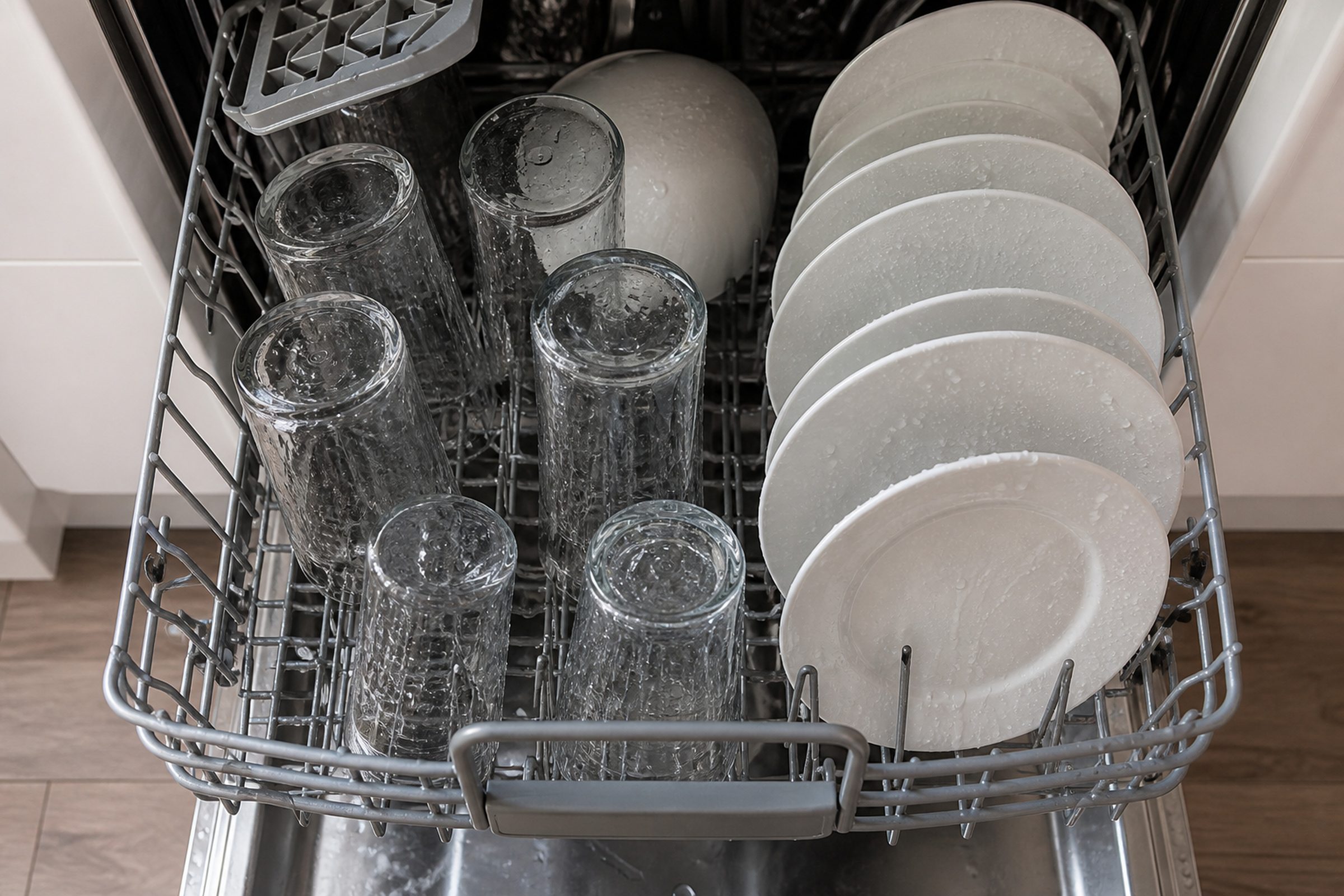
- “Plastics still wet, everything else dry”
- “Water pooled in cup bases”
- “It used to dry and now it does not”
Symptom
Fisher & Paykel dishes not dry at the end of the cycle
Drying on these machines is done with residual heat and a fan rather than a big element, which makes it more sensitive to rinse aid, to loading and to the program than a conventional dishwasher is. Some of what people report here is the machine working as designed.
- From $95 diagnostic, credited to the repair
- 59 cities and neighborhoods covered
- OEM parts available on order
- In writing the price, before anything is opened
Five ordinary causes
What this usually turns out to be
Cheapest and commonest first, which is also the order we check them in. They sit hundreds of dollars apart, and only the unit settles which one is yours.
-
Rinse aid empty or turned down
The commonest cause by a distance on a machine that dries this way. It is a setting and a refill, not a repair.
Dishwasher wash performance repair from $135 -
Plastics, which do not hold heat
This is the machine working correctly. Plastic has no thermal mass, so residual-heat drying leaves it wet while china and glass come out dry.
Dishwasher wash performance repair from $135 -
The drying fan
A fan that has stopped running takes the drying with it. It also removes the reassurance article people read about a fan that runs on — this is its absence rather than its presence.
Dishwasher control & motor repair from $265 -
The heating element
No heat in the wash means no residual heat to dry with. Wet dishes and undissolved detergent together point here.
Dishwasher wash performance repair from $135 -
A cycle ending early
A program that stops before its dry-out phase leaves everything wet and looks like a drying failure. Check what program is being used.
Dishwasher control & motor repair from $265
In five minutes
Before you call anybody
None of it needs tools, and all of it makes the visit shorter.
-
01
Fill the rinse aid
And check its setting, which can be turned down to nearly nothing. Run one load and judge after that.
-
02
Separate plastics from everything else
If china and glass are dry and only plastic is wet, the machine is fine. That is a real answer, and it saves a service call.
-
03
Listen at the end of a cycle
The drying fan should run on. Its absence is worth reporting; its presence is not a problem.
-
04
Feel the dishes when it finishes
Warm and wet is a drying problem. Cool and wet is a heating problem, and that is a different page.
-
05
Then book the visit
Say whether everything is wet or only plastics, and whether the dishes come out warm.
How it shows up
What people describe when they call
In more detail
About Fisher & Paykel dishes not dry at the end of the cycle
The fastest diagnosis is the code
Check the rinse aid before anything else — on a machine that dries with residual heat, rinse aid is not a luxury, it is how the water leaves the surface instead of sitting on it. Then look at whether the drying fan runs at the end: the maker publishes an article reassuring people that a fan running after the cycle is normal, and a fan that does not run at all is the opposite kind of news.
How these machines dry
Not with a big heating element at the end. They use the heat left in the load from the final rinse, helped by a drying fan. That makes them quieter and cheaper to run, and it makes them more dependent on three things: rinse aid, the load, and the wash actually reaching temperature.
What is not a repair
Wet plastics with dry china is the design, not a defect — plastic holds no heat to evaporate with. And a fan that runs after the cycle is the machine doing its job; the maker publishes an article saying so.
What is
A drying fan that no longer runs, a heating element that no longer brings the wash up, and a program that ends before its dry-out phase. Those get a written figure; the rinse aid does not.
This article is based on:
- Official manufacturer documentation
- Internal repair procedures
- Technician repair history
- Company quality standards

Before you book
Questions about Fisher & Paykel dishes not dry at the end of the cycle
The fan keeps running long after the cycle. Is that the problem?
No — that is the machine drying. The maker publishes an article specifically about it because it worries people. The drying fan runs on to pull moisture out of the drawer, and a second fan cools the electronics. What is worth calling about is a fan that never stops on a cold machine, or one that has become noticeably louder.
Only the plastic containers are wet.
That is normal and it is physics rather than a defect. Residual-heat drying relies on the load holding heat and evaporating the water off itself. Plastic holds almost none. Putting plastics on the upper level and giving them a shake before unloading is the whole of the fix.
It used to dry perfectly.
Then something changed. Rinse aid first — an empty dispenser or a turned-down setting explains most of these. After that, the drying fan, and then whether the wash is reaching temperature at all.
Where we do it
Across Miami-Dade, Broward, and Palm Beach
Same terms everywhere we go: an on-site diagnostic first, the price agreed in writing, and the exact figure confirmed once we have seen the unit.
Neighborhoods people ask for by name